

Choosing between conformal coating suppliers is a qualification exercise before it is a purchasing exercise. The supplier needs to understand what must be protected, which failures matter and how your production line will apply and verify the material. A product description can identify a candidate, but a usable supply decision also needs process information, documentation and a realistic route to approval.
For projects considering NanoFlowX, GOLDTEC can support the initial discussion about grade selection and application requirements. This guide explains how to prepare that discussion, compare conformal coating manufacturers and distributors, and request a quotation that reflects the complete process. It is intended for engineering, production and procurement teams buying protection for electronic assemblies.
Write an application brief before contacting suppliers
Describe the assembly and its exposure in operational terms. Identify humidity, condensation, salt contamination, cleaning residues or occasional liquid contact where relevant. Include electrical requirements and any components that must remain accessible. A supplier cannot select responsibly from the phrase waterproof PCB alone, because it does not define exposure duration, operating conditions or the required acceptance test.
Separate mandatory requirements from preferences. An existing customer specification, a restricted materials list or a repair process may limit the candidate materials. A desired application method may be negotiable. State which conditions are confirmed and which still need investigation. This makes the first conversation more useful and reduces the chance that procurement compares products designed for different tasks.
Distinguish the material supplier from the coating service
Some enquiries concern the purchase of coating material; others concern an outsourced application service. These are different scopes. When purchasing material, your team needs to establish preparation, masking, application, handling and verification. When requesting a coating service, the quotation should also define who prepares the assemblies, who owns the process qualification and how nonconforming parts are handled.
Clarify these responsibilities early. Ask whether the offer includes only containers of material, technical selection support, an application trial or additional services. Do not infer a service from a distributor relationship. A clear scope prevents gaps between the supplier's delivery and your production requirements, particularly when a separate contractor applies the coating or when assemblies move between several facilities.
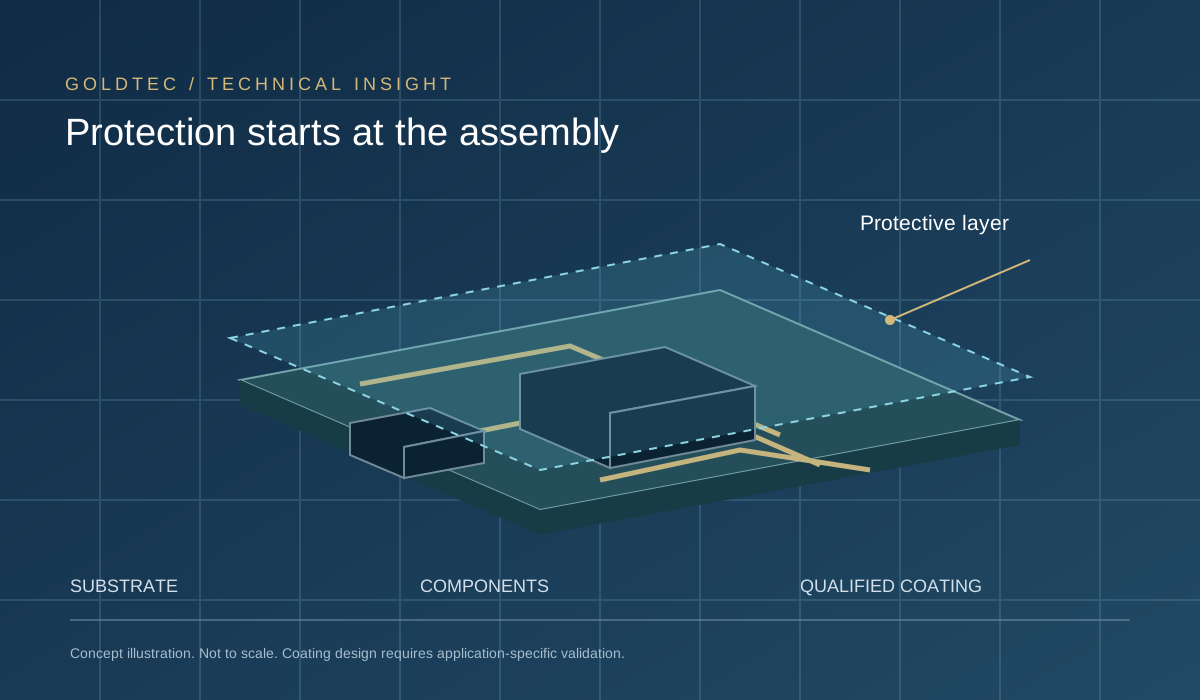
Ask for documents that identify the exact grade
Request current technical and safety documentation for the proposed product. Confirm the grade name, revision and intended application. Different products within one family may have different process requirements and performance claims. Information for one grade should not be used to qualify another merely because both carry the same brand or serve the broad electronics protection market.
Where a test or certification is important, ask for its scope and the relevant supporting document. Check whether the result applies to the material, a test specimen or a complete assembly. A headline rating is useful only when its conditions are understood. Keep the reviewed documents in the project record so that later substitutions or document revisions can be assessed against the original decision.
Evaluate compatibility with the complete assembly
Compatibility includes more than the PCB laminate. Review connectors, labels, plastics, seals, optical parts, switches, heat paths and areas intended for bonding or later rework. Define the keep-out zones and how they will be maintained during application. A coating intended to protect exposed circuitry may create a different problem if it reaches a contact surface that must remain functional.
Preparation also matters. Residues from earlier manufacturing stages can affect the coating process or the protected assembly. Decide how cleanliness is established and checked rather than treating coating as a substitute for cleaning. Use representative boards in the trial, including the most difficult geometries and component combinations. A flat coupon alone may not reveal access problems beneath components or around complex interfaces.
Qualify the process on representative production hardware
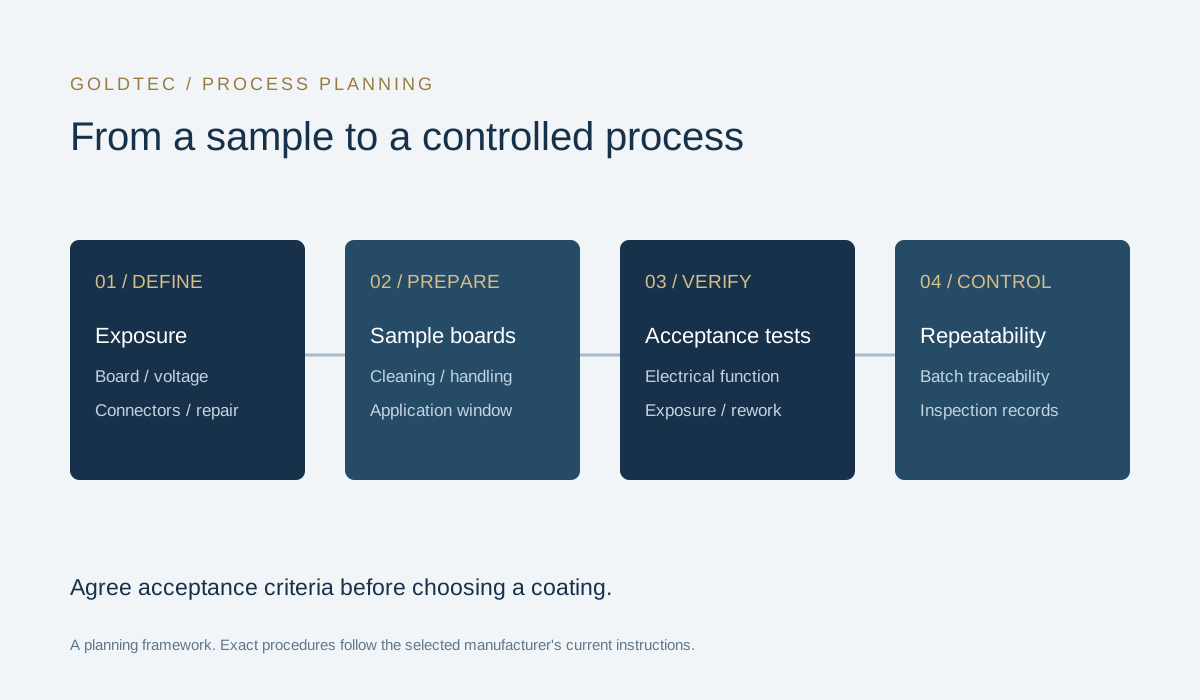
Agree the trial procedure before using valuable assemblies. Identify the candidate material, preparation, application method, handling and acceptance criteria. Define which functional checks occur before and after coating. Include inspection for coverage and unintended deposition where appropriate. If environmental testing is required, specify conditions and pass criteria rather than relying on an informal demonstration with water.
Trial results should lead to a controlled process. Record the steps that produced acceptable assemblies and the variables that need monitoring. Establish how operators identify the material and how changes are approved. Production consistency depends on repeating the qualified conditions, especially when batches, operators or equipment change. A successful sample is the beginning of process control, rather than proof that every future assembly will behave identically.
Where NanoFlowX fits in the discussion
NanoFlowX provides thin protective coating options for electronic assemblies. The useful question is which grade, if any, fits your electrical, environmental and manufacturing requirements. GOLDTEC can help connect the application brief with available product information. The proposed grade still needs verification on the intended assembly and within the process your team will actually use.
When replacing a conventional conformal coating process, compare the required specification carefully. Thickness, inspection method, application behaviour and rework may differ. Avoid assuming that a thinner film automatically satisfies a requirement written for another material system. Document the reasons for the proposed change and the tests that will demonstrate suitability. This allows engineering approval and purchasing decisions to refer to the same technical basis.
Compare the cost per accepted assembly
Container price is only one component of cost. Include preparation time, masking, application, material handling, inspection, rework and rejected assemblies where these are relevant. Confirm the coverage assumptions used in a quotation and whether they reflect your board geometry. A theoretical coverage figure should not be treated as a guaranteed production yield without a process trial.
- Exact product grade and packaging offered.
- Basis for estimating material consumption.
- Required preparation and application equipment.
- Trial quantities and technical support included.
- Storage and handling conditions in the current documentation.
- Supply timing, quotation validity and substitution controls.
- Acceptance responsibilities and the documentation delivered.
Build a quotation request that engineering can approve
Send the same application brief to each candidate supplier so that differences in offers are visible. Ask suppliers to state their assumptions and unresolved questions. If a quotation excludes cleaning, masking or testing, that should be clear before comparing its price with a broader proposal. Procurement can then evaluate commercial terms while engineering checks whether the proposed material and process address the requirement.
Use the enquiry form to contact GOLDTEC about NanoFlowX and electronic protection. Include the assembly type, exposure, production volume, application preference and any mandatory specification. Explain whether you need material selection, a replacement process or support planning a qualification trial. These details create a direct route from an initial search for conformal coating suppliers to a concrete technical discussion and a relevant quotation.
Frequently asked questions
What should I send to a conformal coating supplier?
Send the assembly description, exposure profile, electrical requirements, process constraints, masking needs, production volume and acceptance criteria. Identify unknowns explicitly. A board drawing and representative samples can support a technical discussion once handling requirements are agreed.
Does a coating product rating qualify the complete assembly?
No. Material information supports selection, but the coated assembly must be evaluated against its actual requirements. Connectors, edges, contamination, application coverage and enclosure design can affect the result. Define the relevant verification at assembly level.
Can GOLDTEC help with NanoFlowX selection?
GOLDTEC can help examine a NanoFlowX grade against the stated application and available manufacturer information. Grade selection should be followed by a documented trial on representative hardware and an agreed production process.
How should I compare supplier quotations?
Compare the exact grade, pack size, application assumptions, preparation, coverage basis, required equipment, supporting documentation and trial support. The lowest price per container may not produce the lowest cost per accepted assembly.
Is a thin coating interchangeable with an existing conformal process?
Do not assume interchangeability. Check the required specification, material category, thickness, compatibility and acceptance tests. Changing chemistry or application method can require requalification even when the objective remains moisture or corrosion protection.
Sources and technical references
Manufacturer data applies to a specific grade and system. Define the project specification against the substrate, exposure and current manufacturer instructions.
