

A PCB protective coating should address a defined reliability problem without creating a new functional or manufacturing problem. Moisture, condensation and corrosive contamination can affect electronic assemblies, but their influence depends on the circuit, environment and operating conditions. Selecting protection therefore begins with an exposure profile and a description of what the complete assembly must continue to do.
This guide is for teams comparing electronic protective coatings, conformal coating options and thin films such as NanoFlowX. It explains how to move from broad terms such as waterproof circuit board coating to an engineering decision that can be tested and repeated. GOLDTEC can support material discussions once the application and process constraints are clear.
Define the failure you are trying to prevent
Identify the location and circumstances of previous failures when evidence is available. Ask whether the problem follows condensation, cleaning, exposure to a contaminated atmosphere or a change in operating conditions. Photographs and service records can help distinguish a surface protection problem from a connector, enclosure or thermal issue. A coating will not necessarily address every failure that happens in a humid environment.
Translate the investigation into requirements. State operating conditions, exposure duration, electrical behaviour and the acceptable outcome after testing. If the product has no failure history, use its intended service profile and applicable customer requirements. Keep assumptions visible. This allows a coating candidate to be assessed against the real design objective rather than against an impressive but unrelated demonstration.
Separate board protection from device protection
The circuit board is one part of an electronic device. Connectors, switches, cable entries, seals and enclosure joints may remain vulnerable after a coating process. Some interfaces must remain uncoated to function correctly. A board material claim does not establish the performance of all these interfaces, and a complete device rating should be supported by the appropriate assembly-level verification.
Define which parts the coating process covers and which rely on other design measures. This boundary is especially important when replacing an existing coating or introducing protection into a device already in production. The design team, process team and test laboratory should share the same understanding of the protected area. Otherwise a successful material trial can leave a critical unprotected interface outside the test scope.
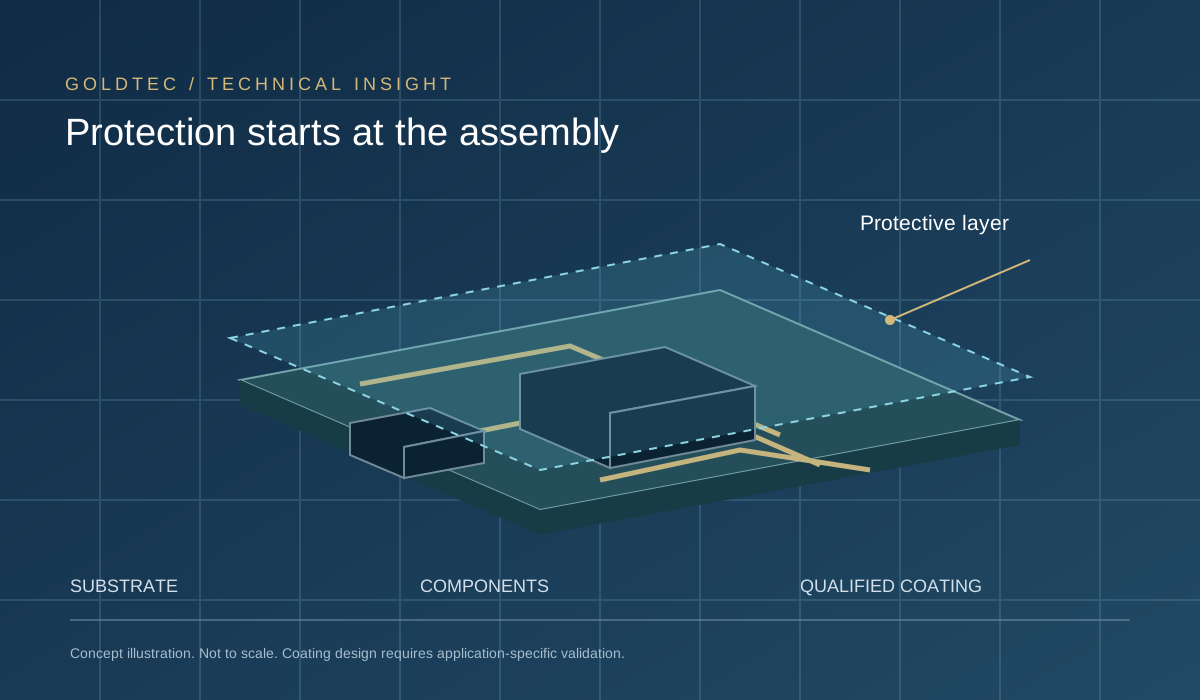
Map compatibility and keep-out requirements
Review the complete bill of materials in the affected area. Plastics, elastomers, labels, optical surfaces, heat transfer interfaces and bonding locations may impose constraints. Identify contact areas and components that must remain accessible for adjustment, inspection or repair. Document keep-out zones in a way that an operator or application contractor can follow consistently.
Compatibility should be investigated with the actual materials and process conditions. Consider the preparation method as well as the coating itself. A cleaner or handling step can influence components even when the final film appears suitable. Include difficult assemblies in the trial, particularly where dense component placement limits access or where local geometries may affect coverage. These details are often missing from a generic coating comparison.
Treat cleanliness as an input to the process
Coating over contamination can preserve a problem beneath the protective layer. Review residues from soldering, handling, cleaning and earlier manufacturing steps. Define the surface condition required by the selected material and determine how the production team will establish and verify it. Visual cleanliness alone may not answer every reliability question, so the method should follow the application and acceptance requirements.
Control the time and handling between preparation and coating. A board that is clean at one station may collect contamination before application. Storage, packaging and operator handling belong in the process review. Establishing these controls before the trial makes the results easier to interpret: if the process changes halfway through testing, it becomes difficult to know whether the material or the preparation caused a difference.
Compare coating systems using the right criteria
Material families and grades differ in application, thickness, handling, inspection and repair. A thinner coating may be attractive for a particular assembly, but thickness alone is not a qualification criterion. Compare the proposed option with the actual specification, including any required material category, process controls and verification. A substitute process may need approval even when both options target moisture protection.
NanoFlowX offers thin protective coating options that can be considered in this selection process. GOLDTEC can help examine the proposed grade using the available manufacturer information and your application brief. Confirm which statements apply to that grade and which tests must still be performed on your own assembly. The product page provides a starting point for a technical conversation.
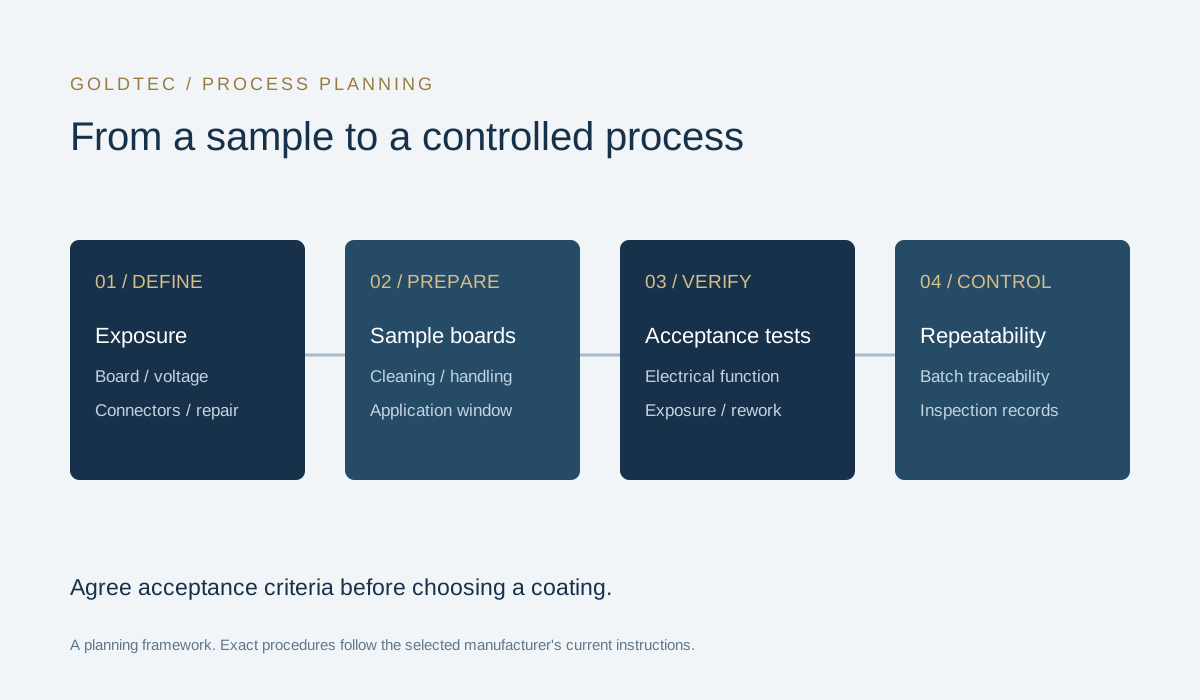
Design a trial that can support a decision
Use representative assemblies and document their condition before coating. Record preparation, material identification, application and handling. Define inspection requirements and the functional checks that will be repeated afterward. If environmental testing is needed, agree the exposure, duration, operating state and pass criteria before starting. An informal splash test cannot substitute for a test plan tied to the service requirement.
Include control samples or other comparisons when they help answer the question. Inspect both intended coverage and unintended deposition in sensitive areas. Record failures and anomalies rather than excluding inconvenient samples from the report. The aim is to learn whether the proposed combination of material and process is suitable, and to identify the conditions needed for repeatable production results.
Plan inspection, repair and production changes
An approved process needs a practical inspection method. Decide what can be checked on each assembly and what requires periodic sampling or additional testing. Define how nonconforming units are identified and handled. Repair requirements should be considered before approval, particularly for assemblies that need component replacement or connector access during service. Check the current product instructions before designing a rework procedure.
Control changes to the material grade, preparation, equipment and process settings. A new supplier batch or a revised assembly may require review, depending on the change. Keep records that connect the approved trial with the production instructions. This makes it possible to investigate a future issue and to distinguish a material change from a change in contamination, handling or circuit design.
Request a focused recommendation from GOLDTEC
Prepare an enquiry with assembly type, exposure conditions, sensitive interfaces, production volume and the required acceptance specification. State whether the project involves a new design, a recurring field failure or replacement of an existing conformal coating. Include process constraints such as application equipment, masking limitations and repair needs. If some facts are unknown, identify them so the next step can address the uncertainty.
Use the contact form to discuss NanoFlowX and PCB protection with GOLDTEC. A focused enquiry helps move the project toward grade review, a representative trial and a quotation with clear assumptions. The useful outcome is a coating process that protects the intended surfaces while preserving device function, with documented evidence supporting the decision to introduce it into production.
Frequently asked questions
Can a PCB coating make any device waterproof?
A coating alone does not establish a waterproof rating for a complete device. Connectors, enclosure joints, access points and operating conditions also matter. Verify the complete assembly or device against its specified exposure and acceptance criteria.
What is the first step in selecting an electronic protective coating?
Define the failure mechanism and the operating exposure. Include electrical requirements, contamination, condensation, cleaning and sensitive components. This application profile provides a better starting point than choosing a material solely by thickness or a generic water demonstration.
Which NanoFlowX grade should I choose?
The grade depends on the assembly, environmental requirements and production process. Review current manufacturer information with GOLDTEC, then qualify the proposed option on representative hardware. Do not transfer a claim from one grade to another.
Should electrical tests be performed after coating?
The test plan should include appropriate functional and electrical checks before and after the process, together with environmental verification when required. The exact checks depend on the assembly and its acceptance specification.
Can a coating be applied without cleaning?
Preparation must follow the selected material and qualified process. Existing contamination can affect performance and reliability. Establish acceptable cleanliness and verify it rather than assuming a coating will neutralize manufacturing residues.
Sources and technical references
Manufacturer data applies to a specific grade and system. Define the project specification against the substrate, exposure and current manufacturer instructions.
